Hi.
Welcome to my blog. I document my adventures in travel, style, and food. Hope you have a nice stay!

Welcome to my blog. I document my adventures in travel, style, and food. Hope you have a nice stay!
The Keystone State Railroad Association (KSRRA) has created a guide that serves as a baseline for any person who would like to learn more about railroad careers in Pennsylvania. The KSRRA’s guide will help potential candidates learn about various positions, job descriptions, and how to best prepare for applying for each. It may not be an exact case-by-case breakdown of each railroad, but it shows possible expectations. It is the hope and goal of the KSRRA to help prepare future railroaders of Pennsylvania – the commonwealth with more railroad companies of all 50 states in the U.S.
Looking to connect to a Pennsylvania Railroad for employment? Check out our railroad members, linked below.
Before a railroad candidate is hired, they must first pass a series of background checks (including but not limited to: driving, criminal, civil, and court records). Any and all employees who are entering a safety sensitive position must pass pre-employment drug test (as required by the Federal Railroad Administration). Railroads also have the right (and requirement) to review a candidate’s previous employment records, drug and alcohol testing results, as well as the aforementioned background checks. Some railroads also require a physical or fitness test.
False information supplied by a newly hired employee is grounds for immediate dismissal.
By and large, this list of requirements will be required for all positions in each railroad company:
Must be 18 years of age or older
Must be a US Citizen
Must pass background testing
Must have a good driving record
Must be a safety-oriented individual
Must be able to follow verbal and written instructions
Must be able to work individually and as a team member
Must be a good team player
Must be able to make quick, responsible, and safe decisions
Must be available to work weekends when necessary
Must have a reliable means of arriving at work on time each day
Must learn and obey all Federal Railroad Administration rules and regulations
Thank you to the American Short Line & Regional Railroad Association for sharing this video - highlighting the careers you can find in a short line railroad!
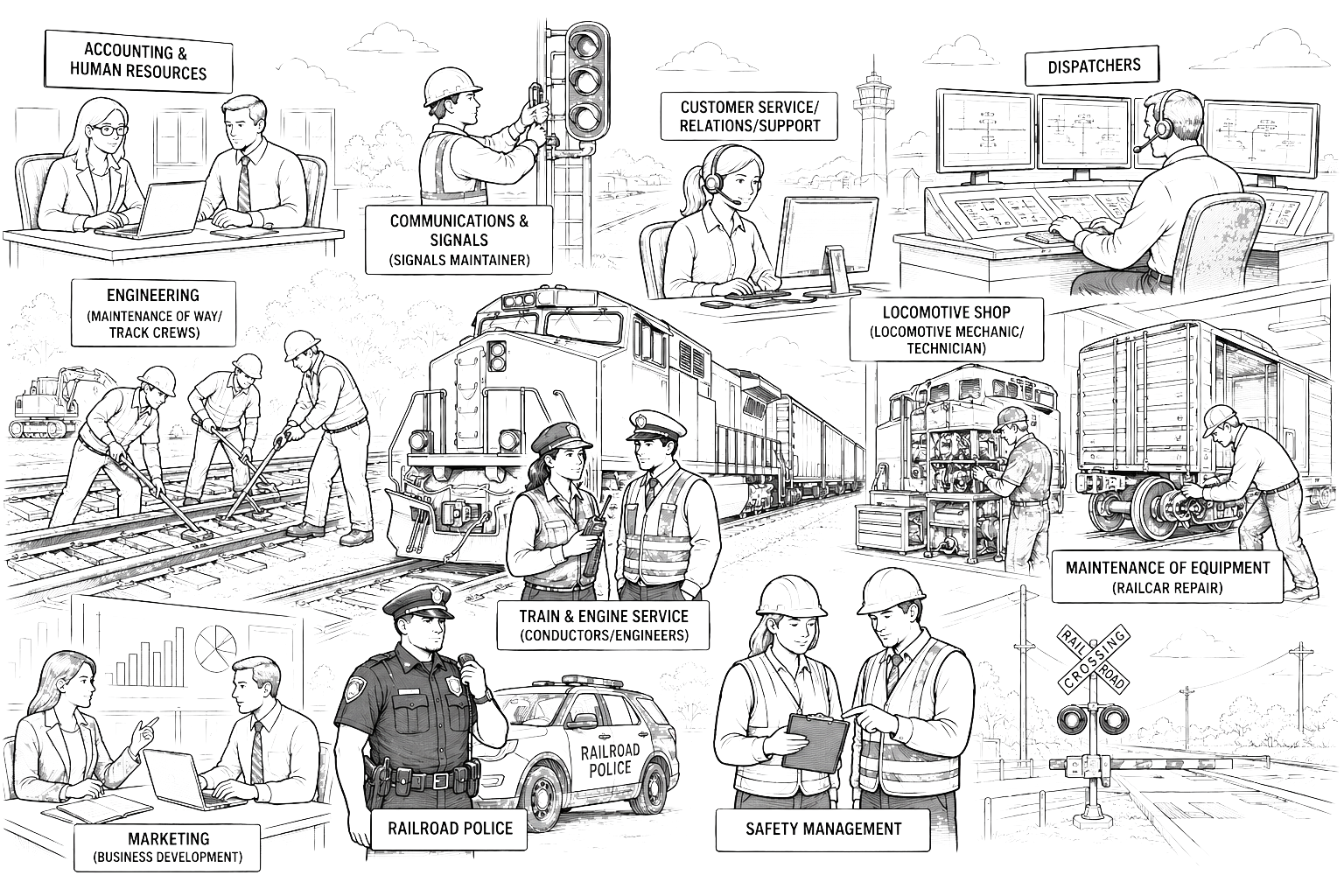
The KSRRA career guide outlines key railroad job paths and their requirements. Below is a structured list of recommended high school academic classes and vocational/technical (CTE) courses for each major railroad career path. Each class is paired with a brief explanation of how it supports the skills, duties, and training expectations described in the KSRRA Railroad Career Guide (e.g. safety culture, mechanical aptitude, electrical knowledge, communication, regulations, physical work readiness, and professionalism).
Positions are listed in alphabetical order.
Accountants must be detail-oriented, have strong verbal and written skills, excel in a fast-paced working environment, and be proficient in math and computer program use.
Academic High School Courses:
Accounting or Business Math: Introduces bookkeeping, financial calculations, and budgeting. The guide notes that railroad accounting/HR staff handle accounts payable/receivable, payroll, taxes, and budgeting. A high school accounting class provides foundational knowledge of financial statements, ledger entries, and tax basics, directly aligning with those duties.
Mathematics (through Algebra/Statistics): Strengthens quantitative skills and attention to detail needed for accurate calculation of payroll, benefits, and tax withholding. Handling forms like W-2s and tax returns requires comfort with numbers and formulas. Statistics can also help in analyzing HR data or budgets.
English & Business Communication: Enhances ability to communicate policies and maintain precise records. Accounting/HR roles demand writing emails, preparing reports, and ensuring clarity when handling confidential information. Strong writing and grammar skills from English class ensure professionalism in internal and external communications.
Vocational/CTE Courses:
Business Administration or Office Technology: Offers training in office software (Excel, Word, QuickBooks) and administrative procedures. KSRRA’s guide stresses proficiency in Microsoft Excel, Word, and accounting software for these roles. High school business tech programs allow students to practice spreadsheets, databases, and general office tasks similar to those in accounting and HR jobs.
Computer Science (Data Management): Develops advanced computer and spreadsheet skills. Managing payroll and HR records involves working with databases and ensuring secure handling of digital information. An information technology or database class teaches data security fundamentals and efficient data organization, supporting the tech-savvy profile needed in modern accounting/HR.
Economics or Personal Finance: Provides context on financial systems, taxes, and money management. This knowledge underpins tasks like processing tax forms and budgeting. For HR, understanding benefits and insurance (covered in personal finance classes) can also be helpful when dealing with employee coverage and reimbursements.
This position requires electrical experience. Signals Maintainers install, maintain, and inspect railroad grade crossing components across the system. They are on call 24/7 in the case they need to mobilize to any signal’s issues, accidents, or reports. All Signals Maintainers must learn and obey FRA rules and regulations.
Academic High School Courses:
Physics (Electronics): Provides a grounding in electricity, circuits, and electromagnetic principles. Signal maintainers need strong electrical knowledge to troubleshoot and test crossing signals, relays, and circuitry. Physics or an electronics unit in science class helps with understanding how signal systems function.
Mathematics: Reinforces logical thinking and measurement skills. Signal maintainers perform precise voltage/resistance tests and timing checks on signal equipment. Math courses (algebra, trigonometry) aid in analyzing electrical values and calibrations.
Computer Science/IT: Introduces programming logic and digital systems. Modern railroad signals may involve microcontrollers or networked monitoring; basic computer knowledge helps maintainers adapt to automated signal control systems and diagnostic software used by railroads.
Vocational/CTE Courses:
Electrical Trades/Electrician Training: Directly aligns with this field’s core duties. High school electrician or electrical technology programs teach wiring, circuit diagrams, and use of testing equipment, which are all essential for installing and maintaining crossing signal components. They also emphasize electrical safety—crucial for working with live signal equipment.
Electronics or Mechatronics: Offers hands-on practice with electronic devices, microprocessors, and control systems. Signal maintainers must inspect and repair complex electronic crossing systems (from flashing light units to timing relays). An electronics or robotics class builds troubleshooting skills for such equipment.
Information Technology/Networking: Some signal systems interface with communication networks. Courses in IT or networking basics can help a future signals technician understand how control systems communicate and how to respond to signal alerts or remote diagnostics.
Construction/Shop Safety: Working on signals often involves outdoor work near tracks and using bucket trucks or boom cranes at roadway crossings. A construction tech or shop class teaches job site safety and how to handle tools at heights, reinforcing the safety mindset needed for signal maintainers.
Qualified candidates must be detail-oriented, have strong verbal and written skills, excel in a fast-paced working environment, possess a friendly, positive attitude, be proficient in computer program use, be detail-oriented, have strong verbal and written skills, excel in a fast-paced working environment, possess a friendly, positive attitude, be able to plan ahead, and maintain a busy schedule. Sales experience is a plus.
Academic High School Courses:
English & Business Communication: Enhances professional writing and interpersonal communication. Customer service and marketing staff must correspond with customers and partners clearly, in person and via email/phone. Classes in English, business writing, or speech help develop a friendly yet organized communication style that these jobs demand.
Intro to Business or Marketing: Provides fundamental understanding of sales, marketing principles, and customer relations. Railroad marketing roles expect knowledge in sales/marketing and business development, including building relationships and developing business opportunities. Early exposure to marketing or economics in high school cultivates these skills and an understanding of commercial aspects of railroading.
Computer Applications: Builds proficiency with common office software (Word, Excel, databases). Both customer service reps and marketing staff use computer systems and industry databases daily to process paperwork (bills of lading, tracking data) and manage customer information. Strong computer literacy from high school IT classes or keyboarding ensures these future employees can hit the ground running.
Vocational/CTE Courses:
Office Technology or Administrative Support: Covers professional software (spreadsheets, word processing) and office procedures. This directly supports customer service duties like managing correspondence, data entry, and documentation, which require proficiency in Microsoft Office and record-keeping.
Logistics & Supply Chain Management: Introduces the flow of goods and transportation logistics. Rail marketing and customer support staff benefit from knowing freight logistics and railcar cycles – for example, how cargo is loaded/unloaded and how railcars move through the system. A high school logistics or supply chain course (if available) teaches these basics, aligning with the guide’s emphasis on understanding rail operations and customer needs.
Business & Sales (DECA or Entrepreneurship Programs): Provides practical experience in business development and customer relations. Marketing/Business Development roles often require sales or marketing experience, so participating in DECA (a student marketing association) or taking entrepreneurship courses can simulate real-world sales scenarios and networking, preparing students for building relationships with clients and industry partners.
Accounting/Finance Basics: Offers familiarity with billing and rates, useful in marketing/customer support roles that handle charges, rates, and billing (e.g. capturing charges, processing invoices). Understanding financial concepts ensures accuracy when dealing with customer accounts and pricing.
Train Dispatchers control the movement of our trains across the freight-rail network. Among their daily responsibilities are giving authority for safe main line movement of trains and maintenance of way; issuing restrictions; communicating with field workers regarding any potential emergencies, including weather; and fielding all emergency calls from railroaders and the public. All Dispatchers must learn and obey FRA rules and regulations.
Academic High School Courses:
Computer Applications & Keyboarding: Develops computer literacy and typing speed. Dispatchers must be computer-proficient (e.g. using dispatch software) and meet typing accuracy standards. Classes in word processing, spreadsheets, and basic coding help future dispatchers navigate complex train management systems.
Geography/Earth Science: Helps in understanding maps, terrain, and weather. Dispatchers coordinate train movements across territories and adjust plans for weather events. Familiarity with geography (maps, distances) and weather patterns can improve situational awareness and route planning in dispatch tasks.
English & Communication: Sharpens skills for clear communication and documentation. Dispatchers must give concise verbal instructions by radio/phone and record all movements with clarity. Strong English classes (and possibly public speaking) improve communication under pressure, while reading comprehension aids in learning FRA rules and emergency protocols.
Vocational/CTE Courses:
Information Technology (IT) or Computer Science: Provides a deeper understanding of operating and maybe even customizing computer systems. Dispatchers often work with advanced Computer-Aided Dispatch (CAD) systems and networked control panels, so IT coursework builds confidence in troubleshooting software and hardware issues.
Logistics & Transportation Management: Introduces principles of supply chain, scheduling, and coordinating movements of vehicles or goods. A high school logistics or transport class can simulate dispatch scenarios, teaching how to optimize routes and timing – directly relevant to managing train traffic efficiently.
Emergency Management/Public Safety (if available): Some vocational programs cover public safety communications or emergency response. Such training aligns with dispatcher duties to handle rail emergencies and safety protocols calmly and effectively.
Track work consists of routine maintenance on railroad tracks, bridges, and right of ways. Track crews will perform manual labor duties, work in a crew to complete duties, and be available for emergency response when extreme weather or other situations impact the railroad structure(s). All trackmen must learn and obey FRA rules and regulations.
Academic High School Courses:
Geometry & Applied Math: Teaches measurement, spatial reasoning, and practical math skills. Track maintenance requires measuring track gauge, calculating grades, and aligning rails – tasks that rely on geometry and measurement skills (e.g. aligning track geometry accurately).
Physical Science: Introduces basic principles of mechanics and materials (for example, the properties of metals and wood used in tracks and ties). This background can help track workers understand how environmental conditions and loads affect rails and bridges.
English/Reading: Develops the ability to read safety manuals and work orders carefully. Track crews must follow written FRA regulations, operating rules, and safety procedures, so strong reading comprehension is valuable.
Vocational/CTE Courses:
Construction Trades or Carpentry: Provides experience with tools, heavy equipment, and construction materials. Track crews often replace wooden ties, repair track structures, and use hand/power tools. Construction/shop classes build tool handling skills, blueprint reading, and respect for jobsite safety – directly applicable to track maintenance tasks.
Welding Technology: Covers welding basics and safety. Track workers sometimes perform rail welding (e.g. Thermite welding) to join rails, and having welding skills gives a head start. Welding courses also teach attention to detail and safety measures, critical for working on track components.
Heavy Equipment Operation (if available): Introduces operation of machinery like forklifts or small excavators. Track crews use powered track maintenance machines (tampers, cranes) and vehicles, so familiarity with heavy equipment controls and maintenance is helpful.
Physical Fitness/ROTC: Track labor is physically demanding – lifting 60–100 lbs and working outdoors in all weather. Strength conditioning (e.g. weight training classes or JROTC physical training) can prepare students for the endurance and fitness needed on the job, reducing injury risk and improving safety.
This position would be a combination of a locomotive machinist, a pipefitter, and an electrician combined into one. The position includes operation of equipment, hydraulic jacks, mechanical jacks, forklift operation. All Locomotive Mechanic/ Technicians must learn and obey FRA rules and regulations. Some mechanics will also become hostlers (driving locomotives to/from maintenance areas, fueling stations, and storage tracks).
Academic High School Courses:
Mathematics (Algebra & Physics): Builds problem-solving and analytical skills vital for diagnosing mechanical issues. Physics teaches concepts of electricity and mechanics that underlie locomotive systems (electrical circuits, pneumatics, hydraulics). Math is used when interpreting technical specifications or measurements.
Chemistry (or Automotive Science): Offers understanding of fuels, lubricants, and material properties, which is useful for working with diesel engines and handling various fluids and materials in locomotives (fuels, coolants, brake fluids).
English/Technical Reading: Enhances skills in reading technical manuals, schematics, and safety rules. Locomotive technicians must read complex maintenance manuals and follow FRA regulations and procedures precisely. Strong reading comprehension ensures no step is missed during repairs.
Vocational/CTE Courses:
Diesel Engine Technology or Automotive Mechanics: Provides hands-on experience with internal combustion engines, drive systems, and vehicle repair. Locomotive mechanics require experience with diesel engines and mechanical systems, so a high school diesel/auto tech program directly builds this knowledge. It also introduces tool use, engine diagnostics, and mechanical safety.
Welding & Metal Fabrication: Teaches welding processes and metalworking. Locomotive shop roles involve welding and cutting for repairs, and welding skill is invaluable for tasks like fixing locomotives’ metal components. This course also instills precision and safety practices around heavy machinery.
Electrical Trades or Industrial Electronics: Develops understanding of circuits, wiring, and electrical safety. Locomotive technicians act as electricians and must read electrical schematics and do wiring. A vo-tech electrical course provides a background in diagnosing electrical systems and using tools like multimeters.
Machine Tool Technology/CAD: Covers machining processes (mills, lathes) and technical drawing. Locomotive machinist skills (fabricating or machining parts) are supported by learning how to shape metal parts and interpret mechanical drawings. CAD (Computer-Aided Design) knowledge can help when understanding locomotive component designs or modifications.
*(Note: Locomotive mechanics often start as apprentices or assistants working under experienced technicians. These vocational classes can streamline the transition into formal apprenticeships or technical training programs after high school.)
The position is for a safety-oriented person who will inspect and repair railcars, in order for train crews to safely handle them in freight traffic. All Railcar Repairmen must learn and obey FRA rules and regulations.
Academic High School Courses:
Math & Geometry: Reinforces measurement, calculation, and spatial skills for tasks like gauging components and interpreting railcar dimensions or brake parameters. Basic math proficiency is needed for reading measurement tools and performing load calculations during repairs.
Physical Science: Introduces mechanical principles and metal properties, relevant since railcar repairers inspect structural components and braking systems. Understanding how forces and materials behave (e.g. metal fatigue, pressure in air brake lines) aids in repair decisions and safety.
English/Reading: Sharpens ability to follow detailed maintenance manuals and safety rules. Railcar repairers must adhere to Federal Railroad Administration (FRA) rules and the AAR (Association of American Railroads) repair manuals for inspections, so strong reading comprehension is important.
Vocational/CTE Courses:
Welding & Metalworking: One of the most critical skills for railcar maintenance. Welding experience is explicitly required for many railcar repair jobs, since repairing railcar bodies and frames often involves cutting and welding steel. High school welding courses train students in safe welding practices and metal repair techniques, aligning with railcar maintenance duties.
Machining or Metal Fabrication: Provides experience with metal tools and fabrication, helpful for replacing or manufacturing railcar parts (e.g. couplers, brake components) and using shop machinery. This supports the mechanical aptitude needed to handle diverse repairs and read measurements or part diagrams accurately.
Automotive or Diesel Mechanics: Offers broad mechanical systems knowledge and practice using hand tools, which translates well to railcar brake systems, suspension, and other mechanical components. Railcar technicians diagnose and replace parts (like brake shoes, hoses, valves) similar to heavy vehicle maintenance, so auto/diesel shop classes build foundational skills.
Electrical Systems: Introduces basic electrical repair—useful because railcar repairers use electrical tools and sometimes fix wiring or signal components on freight cars. Understanding circuits and electrical safety complements the mechanical repair skill set.
Railroad Police are specialized law enforcement professionals responsible for ensuring the safety and security of railroad property and employees. They investigate crimes, prevent trespassing, and enforce laws on and around railroad facilities.They focus on patrolling and responding to incidents and develop security strategies.
Academic High School Courses:
Government/Civics or Criminal Justice (if available): Introduces law enforcement principles and legal systems. Railroad police must understand and enforce federal/state laws and railroad regulations. Civics or a school criminal justice elective can provide background on legal procedures, rights, and law enforcement ethics – a strong base for police academy training.
English & Writing: Critical for developing report-writing skills. Railroad police write detailed incident reports and communicate with various agencies, so high school English and writing classes build the ability to describe events clearly and logically. Public speaking or debate can also help future officers practice clear verbal communication and confidence.
Physical Education & Health: Emphasizes fitness and wellness, preparing students for the physical demands of law enforcement (railroad police must pass agility tests and handle strenuous activity). Consistent participation in PE classes or school sports helps build strength, endurance, and teamwork – all important for a career in policing.
Vocational/CTE Courses:
Law Enforcement or Protective Services Programs: Many vocational high schools offer criminal justice or cadet programs where students learn about policing techniques, investigative procedures, and self-defense. This aligns with railroad police duties like investigating crimes, patrolling, and emergency response on railroad property. It also often provides basic security certification or CPR/first aid training, complementing the required police academy after high school.
Cybersecurity/Information Technology: Covers digital security and investigative tech tools. Modern railroad police also handle computer systems and surveillance equipment, so IT skills (cybersecurity, databases, evidence tracking software) are increasingly relevant. A technical course can prepare students to navigate these tools effectively in law enforcement contexts.
Emergency Medical Responder (EMR) Training: If available, this trains students in first aid and emergency response. Railroad police often respond to accidents or incidents on the railway and may need to administer first aid or coordinate emergency services. Having an EMR or basic first aid certification in high school provides a useful head start and demonstrates commitment to public safety roles.
Railroad company safety departments are responsible for supervising and coordinating work activities of all departments, ensuring compliance with federal laws and company policies, promoting safety initiatives, and developing safety plans. They must learn and obey FRA rules and regulations.
Academic High School Courses:
Chemistry or Environmental Science: Builds knowledge of hazardous materials and chemical safety. Railroad safety managers oversee hazmat training and compliance and environmental safety procedures, so understanding chemical properties and environmental impacts is valuable.
Biology/Health: Provides background in human safety, first aid, and health, which connects to occupational safety and first aid/CPR training required in railroad safety roles. Health classes also instill knowledge about human factors, injury prevention, and ergonomics.
Government/Civics: Introduces the structure of laws and regulations. Safety officers must ensure compliance with federal safety laws (FRA, OSHA), so a foundation in civics or an elective on business law/regulations helps in grasping how regulations work.
Statistics or Math: Teaches data analysis – useful for tracking safety performance metrics (e.g. injury rates, incident counts) as noted in safety manager duties. Analytical math skills help safety professionals interpret trends, perform risk assessments, and develop data-driven safety improvements.
Vocational/CTE Courses:
Occupational Safety & Health (OSHA Certification): If offered through a career-tech program, an OSHA-10 or OSHA-30 general industry safety course is directly relevant. The guide highlights OSHA 10/30 training as valuable for safety roles. These courses teach workplace hazard recognition, accident prevention, and safety regulations – an excellent primer for a future safety manager.
Public Safety/First Responder Training: Programs like emergency medical responder or firefighting introduce incident command and emergency response. Safety managers coordinate accident responses and must have first aid/CPR and emergency preparedness training, so early exposure to public safety skills is beneficial.
Industrial Arts or Engineering Classes: Classes that emphasize project safety (like shop safety in woodworking or lab safety in engineering projects) cultivate the safety-first mindset needed to lead safety programs in a railroad environment. These courses also improve familiarity with technical workplaces, tools, and machinery, giving insight into how accidents can be prevented.
Railroad Conductors manage the safe and efficient operation of freight train operations. Their duties include supervising the movements of the train and communicating important information to the engineer.
Locomotive engineers are responsible for driving freight trains safely between stations. Their job is to inspect the locomotive before use, operate the train using manual and computer controls, and monitor the instruments such as train speed, battery use, and air pressure.
Academic High School Courses:
Physics: Teaches principles of motion and mechanics (e.g. forces, momentum) relevant to train operations. Understanding concepts like energy, friction, and braking helps in safe train handling and controlling in-train forces.
Advanced Math (Algebra & Geometry): Develops problem-solving skills and precision. Conductors and engineers must calculate speeds, distances, and schedules accurately, plus interpret instrument readings (speed, air pressure gauges) on locomotives.
English/Communications: Sharpens ability to follow written procedures and communicate clearly. Conductors relay critical information to engineers and use radio protocols, so courses in English, technical writing, or public speaking help build clear verbal and written communication skills.
Vocational/CTE Courses:
Automotive or Diesel Technology: Provides hands-on experience with engines and mechanical systems similar to locomotive diesel engines. Locomotive engineers and conductors benefit from basic engine knowledge (how engines, brakes, and controls work) since they inspect and operate diesel locomotives. These classes build mechanical aptitude and familiarity with tools and safety procedures.
Industrial Technology & Electronics: Offers experience with basic electrical circuits, controls, and industrial equipment. Modern locomotives use computerized control systems and electronic monitoring, so exposure to electronics or robotics classes helps future engineers understand signal systems and troubleshooting.
Safety or First Aid Certification: Many railroads emphasize a strong safety culture – all employees must use personal protective equipment (PPE) and follow strict safety rules. If available, OSHA-10 safety training or first aid/CPR courses in high school build early awareness of safety practices. This aligns with railroad requirements like on-track safety briefings and hazard knowledge in Train & Engine service roles.
Each of these suggested courses is commonly available in high schools or vocational-technical schools. By choosing relevant classes, a student can build the mechanical aptitude, electrical know-how, safety consciousness, communication skills, and physical readiness needed for a railroad career. This targeted preparation not only helps in meeting hiring expectations but can also lead naturally into post-secondary training (like apprenticeships, certifications, or college programs). Taking these classes in high school will give aspiring railroaders a strong foundation in the skills and mindset needed to thrive in various railroad industry paths.
There are a number of places where you can go to begin your railroad education (before applying with a railroad).
The KSRRA does not endorse any of these programs, and completing these programs will not guarantee a candidate to be hired with a railroad, but we wanted to make these options available to anyone interested.
Penn State Altoona Rail Transportation Engineering (RTE) https://altoona.psu.edu/academics/bachelors-degrees/rail-transportation-engineering
Penn State University in Altoona, PA
College Course
Majoring in Penn State Altoona’s ABET-accredited Rail Transportation Engineering program offers a unique opportunity to be part of an industry that is undergoing significant growth and modernization. With a wide range of career options, excellent job prospects, and the chance to make a positive impact on society, our railway engineering degree is an excellent choice for those passionate about engineering and transportation.
National Railway Historical Society Railcamp(s)
https://nrhs.com/programs/railcamp/
University of Delaware in Newark, DE
High School Level
RailCamp is an educational experience for high school students who have an interest in railroads and railroading. The program is designed to teach students about 21st century railroad operations, dispatching, and maintenance while providing a simultaneous experience in the early history of U.S. railroads in the development and settlement of our country. Students will learn both modern and historic elements of America’s most vital transportation mode, including how diesel, electric, and steam locomotives function, how track is built and maintained and how early freight and passenger cars were constructed.
Texas Railway Analysis & Innovation Node (TRAIN)
https://sites.utexas.edu/train/education-and-training/
University of Texas in Austin, TX
K-12
TRAIN is dedicated to developing the next generation of railway transportation engineering leaders by offering courses dedicated to railway topics and introducing railway content to other Civil Engineering courses at UT. The TRAIN team also engages in rail-themed outreach to K-12 students.
Johnson County Community College, Railroad Science
https://www.jccc.edu/academics/credit/railroad-science/
Johnson County Community College in Overland Park, KS
College Course
The Railroad Conductor Certificate Program prepares you for an exciting and well-paying career as a railroad conductor.
University of Delaware Railroad Engineering Program
https://railroadengineering.engr.udel.edu/
University of Delaware in Newark, DE or Online
Continuing Education College Credits
The Railroad Engineering and Safety program at University of Delaware is housed within the Department of Civil and Environmental Engineering. It offers courses to undergraduate, graduate, and professional & continuing education students.
University of Denver Transportation & Supply Chain Operations Certificate
https://transportation.du.edu/certificates/transportation-supply-chain-operations-certificate
University of Denver in Denver, CO
College-Level Certificate Program
Transport modes have grown over time to include maritime (ships and barges), surface (rail, trucks, and vans), air (planes, helicopters, and drones), and underground (pipelines). Students will learn about the characteristics of these modes and the nodes with which they interact including ports, terminals, distribution centers, and flow centers. Whether working for a manufacturer, distributor, retailer, or e-tailer, students learn how to effectively manage transportation, which is a key factor in profitability and customer satisfaction.
National University Rail Center of Excellence (NURail CoE)
https://nurailcoe.railtec.illinois.edu/
University of Illinois Urbana-Champaign, University of Illinois Chicago, University of Delaware, Kansas State University, Michigan Technological University, Morgan State University, Rutgers University, University of Texas at Austin, and Tuskegee University
K-12 and College-Level options
The National University Rail Center of Excellence (NURail CoE) is a nine-university consortium led by the University of Illinois Urbana-Champaign (UIUC) and is the first academic research and education center to be supported by the U.S. Department of Transportation Federal Railroad Administration. Our mission is to develop solutions that will lead to a safer, more efficient, and reliable passenger and freight rail transportation system and rail infrastructure in the United States. NURail CoE will attract, inspire, and educate a new generation of students in railway transportation engineering and provide them with the knowledge to implement these solutions in their pursuit of rail careers.
University of Illinois Rail Transportation and Engineering Center (RailTEC)
https://railtec.illinois.edu/
University of Illinois in Urbana, IL
College-Level degree programs and courses
RailTEC is home to a strong group of faculty and students from all branches of engineering, systems analysis, and transportation economics engaged in leading-edge interdisciplinary railway research and education activities at the University of Illinois at Urbana-Champaign.
Diesel and Power Systems Technology
https://www.src.edu/academics/career-programs/diesel-and-power-systems-technology
Spoon River College in Canton, IL
College-Level degree programs and courses
The Diesel and Power Systems Technology program offers education and training in the ever-changing field of diesel power technology and its related applications. The SRC program takes great pride in the fact that students are exposed to a wide variety of brands of diesel equipment. The two-year program has prepared hundreds of students for employment in the fast-paced industry of diesel power. Small class size and fully equipped labs allow students the opportunity to gain quality hands-on experience.
Rail Transportation Program (RTP)
https://www.mtu.edu/mtti/rail/education/
Michigan Tech in Houghton, MI
High School to College-Level courses and programs
The RTP is multi-disciplinary and open to a wide range of degree programs for undergraduate students. Students can either complete a series of courses applicable to the minor in Rail Transportation, or simply take individual courses.
Rail Management Certificate Program
https://execed.broad.msu.edu/public/category/courseCategoryCertificateProfile.do?method=load&certificateId=1027719
Various Locations/Courses
College-Level Certificates
The program is aimed at individuals in the rail industry with the potential to become senior managers and leaders in their organizations. Content is applicable to the whole rail industry – freight and passenger railroads, transit authorities, industry & regulatory agencies, suppliers, and shippers. Critical and topical subjects are covered in a classroom setting with interactive discussions. Site visits are included to aid learning. These include railroad facilities, customers, suppliers, associations, and agencies. Group project work applies learning and develops teamwork skills.
National Academy of Railroad Sciences (NARS)
https://www.narstraining.com/training-courses/
Overland Park, Kansas
Training Courses
Brought to life by highly qualified instructors with extensive backgrounds in the railroad industry, NARS’ wide range of courses were developed by training experts with the training needs of current railroad professionals in mind. Many of these courses are presented in the classrooms and laboratories of our Johnson County Community College (JCCC) facility, where trainees will work on mastering necessary job skills in environments that simulate real on-the-job conditions.
Modoc Railroad Academy
https://www.modocrailroadacademy.com/
Pleasant Grove, CA
Training Courses
Modoc Railroad Academy offers hands‑on training programs for careers such as conductor and certified locomotive engineer, combining classroom instruction with on‑site, practical experience on real rail equipment. Their curriculum includes teaching safety protocols, operating rules, signaling systems, braking systems, hazardous materials handling, and other essential topics to prepare students for work in the railroad industry.